The boutique as editor
A department store aims for breadth. An independent boutique, at its best, does the opposite: it narrows. Someone has looked at dozens of collections and chosen a few pieces that fit a point of view. When you shop there, you are borrowing that judgement. For a minimalist dresser this can be enormously helpful, because a good edit removes the noise before you arrive. It can also be misleading, because a beautifully lit room and a quiet soundtrack can make ordinary clothes seem exceptional.
Some shops have made editing itself famous. Dover Street Market, founded in London in 2004 by Rei Kawakubo and Adrian Joffe, presents collections as installations, deliberately mixing makers and price points. Smaller neighbourhood boutiques work at a different scale, often carrying a handful of labels in depth. Neither model is automatically better. What matters is whether the edit is coherent, informed and honest.
Reading the rail
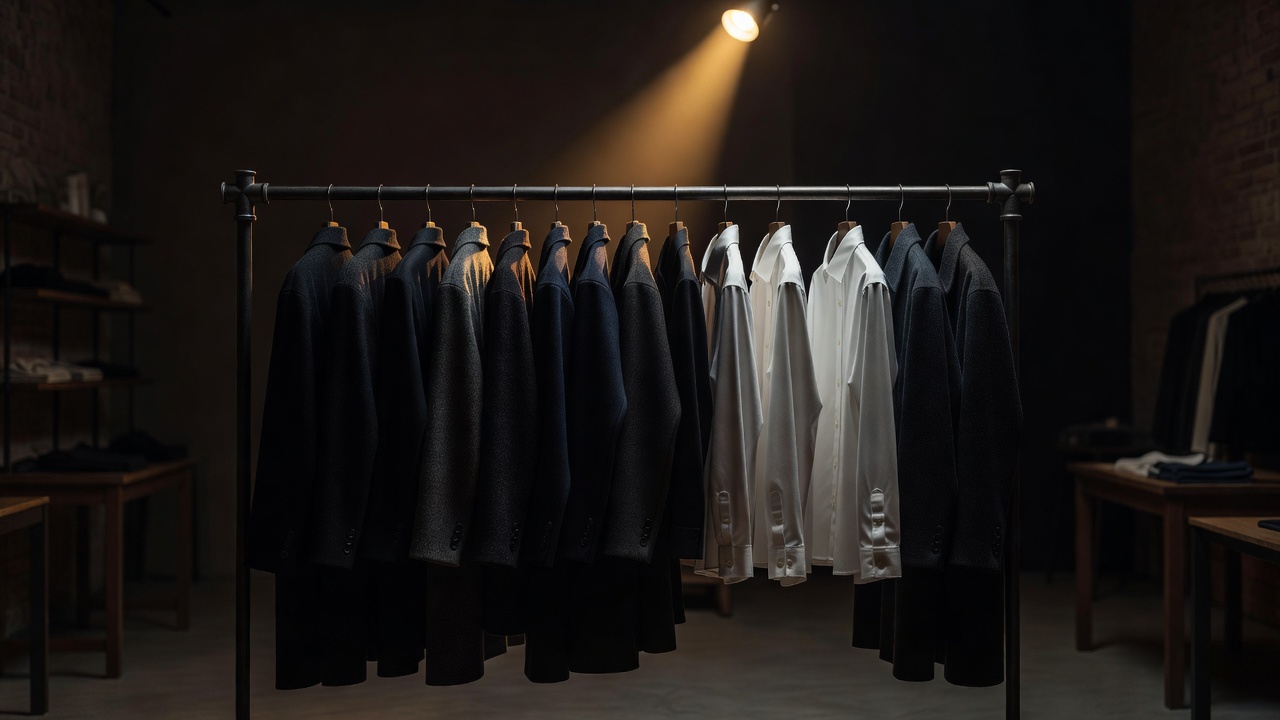
Begin by looking at the rail as a whole before touching anything. A considered boutique tends to show a consistent standard of making across its stock. If a beautifully constructed wool trouser hangs beside a thin, poorly finished shirt at a similar price, the edit is inconsistent, and you will need to check every piece yourself. Look for depth as well as breadth: a shop that carries a trouser in several sizes and two or three colours is usually committed to it, rather than buying a single sample to fill space.
Presentation offers further clues. Garments hung on appropriate hangers, with shoulders supported and trousers clipped or folded along their creases, suggest staff who understand how clothes age. Knitwear left on hangers to stretch, or crumpled stock at the back of a rail, suggests the opposite. These are small things, but they reflect whether the shop treats clothing as something to be looked after.
Divider-separated quality cues
Use these as prompts, not as a score. A shop can miss one and still be excellent; a shop that misses most deserves caution.
- Makers are namedLabels, workshops or countries of origin are stated openly.
- Fibre is explainedStaff can describe a fabric without reading the tag.
- Alterations are offeredHemming or referrals to a local tailor.
- Returns are clearTerms are written down and easy to find.
- The edit is consistentSimilar standards of making across price points.
- No pressureYou are encouraged to try, think and come back.
Questions worth asking
Good staff welcome questions, and the quality of their answers is itself a measure of the shop. Ask where a garment was made. Since the Rana Plaza factory collapse in Bangladesh in 2013, the campaign group Fashion Revolution, founded by Carry Somers and Orsola de Castro, has encouraged shoppers to ask brands a simple question: who made my clothes? A boutique that knows its suppliers can usually answer at least in outline. Vague replies are not proof of wrongdoing, but they suggest the shop is not close to its makers.
Ask how the piece should be cared for and how it is likely to wear. Someone who has handled a fabric for a season can tell you whether a merino jumper pills, or whether a linen shirt softens pleasantly with washing. Ask whether alterations are possible. And ask what the shop itself would choose from the rail, which often reveals the pieces they believe in most.
Labels, prices and returns
Read the label inside every garment you consider. Fibre composition and care instructions are required information in the United Kingdom and European Union, and they are your clearest guide to how a piece will behave. A high price paired with a fibre blend you would not accept elsewhere is worth questioning politely.
Returns policies vary between independent shops, particularly for sale items and altered garments. In the United Kingdom, buyers have statutory rights under the Consumer Rights Act 2015 when goods are faulty, and additional cancellation rights generally apply to online purchases. Beyond those rights, a shop's own goodwill policy is a choice, and a clearly written one indicates confidence in the stock. This index does not provide legal advice; check the official guidance in your country for details.
Shopping boutiques online
Many independent boutiques sell online, which removes the chance to turn a garment inside out. Compensate by looking for detailed measurements rather than size labels alone, close photographs of seams and fabric, and descriptions that name fibre weight and origin. Shops that publish flat measurements for every size make it much easier to compare against the pieces you already own, as described in our guide to proportion.
What if the shop cannot answer where something was made?
Treat it as missing information rather than a verdict. Check the label, search the maker's own site, and weigh the answer alongside the construction you can see.
Are smaller rails always better?
No. A small rail can be careless and a large one meticulous. Look for coherence and consistent standards rather than size.
Should I trust in-store styling?
Use it for ideas, but judge each garment alone. Styling can flatter a piece that will not combine with anything you already own.