Repetition as a measure
The industrial designer Dieter Rams summarised his philosophy as "Weniger, aber besser" — less, but better. The phrase is often borrowed by minimalist dressers, sometimes too literally. Fewer things is not the goal in itself. Better things, worn more often, is closer to the spirit of it. Repetition is the measure that connects the two: a garment you wear every week has proved its value in a way that a garment admired in the wardrobe has not.
This index deliberately avoids prescribing a number. Approaches such as Courtney Carver's Project 333, which invites people to dress with thirty-three items for three months, have helped many readers reset their habits, and they can be a worthwhile experiment. But a fixed count can also encourage people to discard serviceable clothes or to buy replacements to fit a scheme. We prefer to ask a simpler question of each piece: how often, and how happily, is it worn?
There are environmental reasons to value repeat wear as well as personal ones. WRAP, the UK charity that studies waste and resources, estimated in its Valuing Our Clothes research that extending the active life of clothes by nine months could reduce their carbon, water and waste footprints by around 20 to 30 per cent. Wearing what you already own is, in that sense, among the most effective decisions available to any dresser.
Variety without acquisition
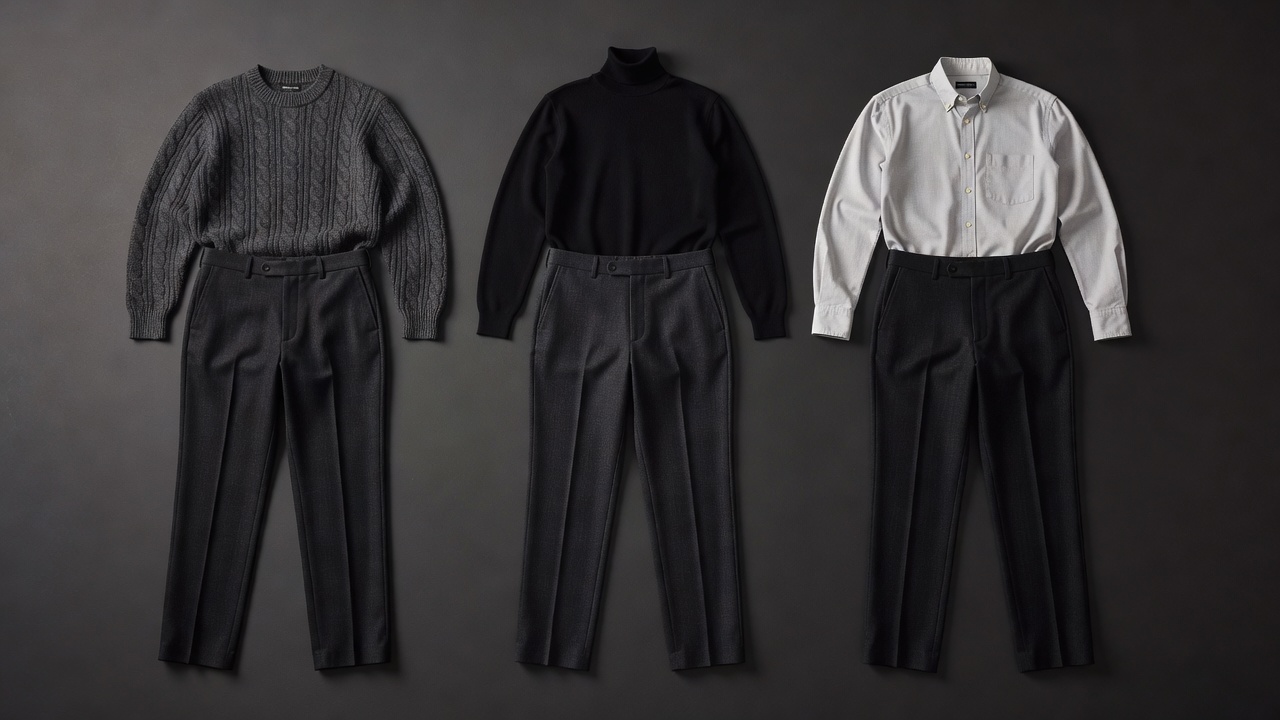
The worry about repetition is monotony, the sense of wearing a uniform you did not choose. Some people embrace the uniform deliberately; Steve Jobs's black mock turtlenecks, made for him by Issey Miyake, are the familiar example. Most of us want a little more movement. Three sources of variety are available without buying anything new.
The first is texture. A wardrobe in narrow colours becomes far more interesting when it mixes surfaces: dry, crisp cotton poplin against a brushed lambswool; matte wool flannel beside a slightly lustrous silk; raw denim next to a soft, washed linen. The eye reads texture as variety even when the colours barely change.
The second is layering. The same white shirt reads differently worn open over a knit, buttoned under a coat, or tucked beneath a sleeveless jumper. The third is the considered accent: a single scarf, belt or piece of jewellery that alters the emphasis of a familiar outfit. One accent at a time is usually enough to keep the overall line calm.
Care that makes repetition possible
Clothes that are worn often need care between wears, not just after them. Wool in particular benefits from rest: hanging a jacket or trouser for a day or two allows fibres to recover and creases to fall out. Rotating between two similar pieces rather than wearing one every day can extend the life of both. Airing garments after wear, brushing wool to remove surface dust, and washing less often but more gently all help.
Read the care label before washing, following the symbols coordinated by GINETEX. Many knitwear and trouser fabrics last longer when washed cool and dried flat or hung, away from direct heat. Small repairs, such as reattaching a button or closing a seam that has begun to open, are best done as soon as they are noticed; the construction guide explains which seams are easiest to mend.
| Fabric | Between wears | Common mistake |
|---|---|---|
| Wool suiting and flannel | Hang on a shaped hanger; brush; rest a day | Washing after every wear |
| Knitwear | Fold flat; air out; de-pill gently | Storing on hangers until it stretches |
| Cotton shirting | Hang immediately; wash collars and cuffs carefully | Hot tumble drying |
| Linen | Hang while slightly damp to ease creases | Over-pressing, which can create shine |
Knowing when a piece has earned its place
After a season, look honestly at what you have worn. Pieces that appeared again and again are your foundations; they deserve the best care and, when the time comes, a thoughtful replacement in the same spirit. Pieces that hung untouched are worth examining rather than discarding at once. Was the problem fit, fabric, occasion or simply habit? The answers will make your next purchase better informed, which is the real purpose of this index.
A simple wear log
For four weeks, note what you wear each day in a notebook or phone. The record is usually more revealing than any rule.
Signs a foundation piece needs replacing
Thinning at the elbows or seat, fabric that no longer recovers, or seams that have been repaired more than once in the same place.
Passing on what you do not wear
Resale, swaps, alteration or donation keep clothes in use. Clean and repair pieces before passing them on.