Silhouette before style
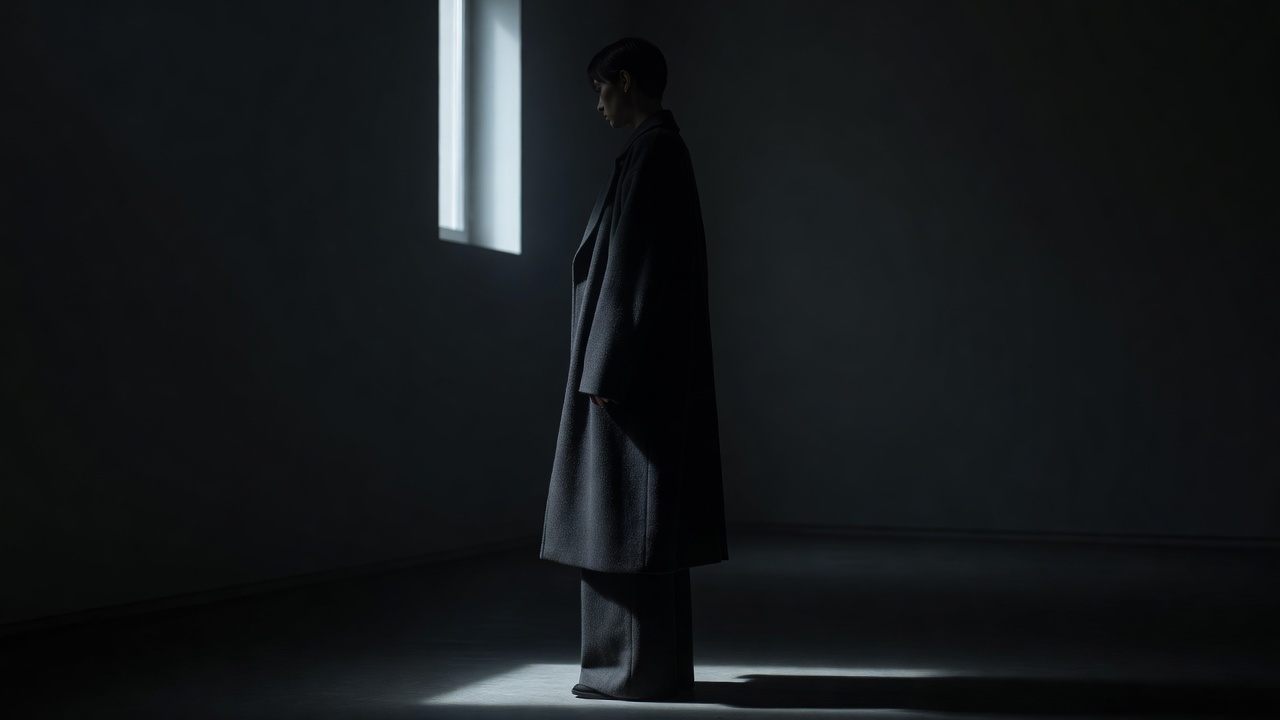
Every outfit has an outline, the shape it makes against a wall. In decorated clothing that outline competes with pattern, embellishment and colour. In minimalist clothing it is often the most noticeable thing about you. A wide-legged trouser with a short, boxy jacket says something very different from a slim trouser under a long coat, even when both are in identical charcoal wool.
Fashion history offers useful reference points. The American designer Claire McCardell, working from the 1930s to the 1950s, built practical, unfussy clothes around the moving body, popularising wrap dresses and separates that could be combined freely. In the 1970s Halston pared evening dress to fluid columns of fabric. Later, Jil Sander became known for exacting tailoring with almost nothing extra, while Margaret Howell has spent decades refining British workwear proportions. In Japan, Yohji Yamamoto and Issey Miyake treated volume and drape as the subject of a garment rather than a by-product. None of these approaches is the correct one. Each simply shows that restraint can take many shapes.
The four landmarks of fit
Tailors read fit from a handful of points on the body, and learning them makes shopping faster and less frustrating. The first is the shoulder. On structured jackets and coats the shoulder seam should end at, or just beyond, the edge of your own shoulder bone. Shoulders are the hardest part of a garment to alter, so this is the point on which to be least flexible. Dropped shoulders on knitwear and relaxed shirting are a deliberate choice, but they should look intended rather than oversized by accident.
The second landmark is the rise of trousers and skirts, the distance from the crotch seam to the waistband. A higher rise lengthens the leg line and pairs naturally with tucked shirts and cropped jackets; a lower rise sits better under longer tops. The third is sleeve length. On a jacket, a little shirt cuff showing at the wrist is the traditional proportion, while knitwear sleeves that bunch at the hand tend to look careless after a few wears. The fourth is hem length, which governs where a garment stops and therefore where the eye pauses.
| Landmark | Well judged | Warning sign | Alterable? |
|---|---|---|---|
| Shoulder | Seam at the shoulder edge; no dimple below | Divot in the upper sleeve, collar lifting off the neck | Rarely, and expensively |
| Rise | Waistband sits where intended without pulling | Horizontal creases at the front, sagging seat | Limited |
| Sleeve | Ends at the wrist bone on jackets | Covers the knuckles, twists when arm hangs | Usually yes |
| Hem | Deliberate break or clean crop | Pooling fabric, uneven drop front to back | Yes, given allowance |
Finding the line you return to
Most people already have a preferred silhouette, even if they have never named it. The quickest way to find yours is to look at the clothes you actually wear rather than the ones you admire. Lay out the five pieces you reached for most in the last month. Measure the trouser rise, the jacket length, the hem of your favourite skirt or the drop of a favourite jumper. Patterns usually emerge quickly: perhaps you favour a straight leg cropped at the ankle, or a hip-length top that ends just below the waistband.
Once you know these numbers, you can carry them into shops. Comparing a new piece against a known measurement is more reliable than trusting a size label, which varies considerably between brands and countries. It also helps you resist garments that are beautifully made but drawn on a line you will not wear.
Balancing volume
A common principle in restrained dressing is to balance volume: if one part of an outfit is generous, let another part be close. A full trouser with a fitted knit, or a slim trouser with a roomy coat, keeps the overall shape legible. This is a starting point, not a law. Designers such as Rei Kawakubo at Comme des Garçons have deliberately abandoned balance to question how bodies are supposed to look. The value of the principle lies in knowing when you are following it and when you are choosing not to.
Proportion also interacts with fabric. A heavy wool holds a sharp outline and suits structured shapes; a fluid crepe or washed silk falls close to the body and suits drape. Asking a stiff fabric to behave fluidly, or a soft fabric to hold a strict line, usually disappoints.
Fitting-room checks
Raise your arms
Lift both arms forward. A jacket that pulls hard across the back or rides up at the collar is too narrow through the shoulders or back.
Sit down
Trousers should allow you to sit without the waistband digging in or the seat straining. Watch for the hem rising too far.
Look from the side
Use a side mirror. Front views hide forward-leaning hems and jackets that swing away at the back.
Check the hem in your own shoes
Trouser breaks change with heel height. Judge length with the footwear you will most often wear.
Compare with your known measurements
Bring a note of the rise, inseam and jacket length of pieces you already love, and compare directly.